


Recycled Materials in Industrial Forging: Feasibility and Current Challenges
Did you know steel is one of the most recycled materials in the world? In industrial forging, though, the question isn’t whether it can be recycled — it’s how much, and under what conditions. Talking about sustainable forging means talking about a real technical challenge, not just an environmental goal.
In 2026, that debate has taken on a new dimension: ESG (Environmental, Social, and Governance) criteria have gone from a differentiator to an entry requirement for industrial tenders. And regulatory pressure — with the EU’s Carbon Border Adjustment Mechanism (CBAM) fully in force since January — is changing the rules of the game for manufacturers, EPC (Engineering, Procurement, and Construction) integrators, and procurement departments.
Recycling fundamentals in the forging industry
Before assessing recycled steel’s viability in industrial forging, it’s worth understanding what materials are actually in play, how they’re transformed, and why they aren’t interchangeable. The answers to those three questions largely define sustainable forging’s real ceiling.
What counts as recycled material in industrial forging
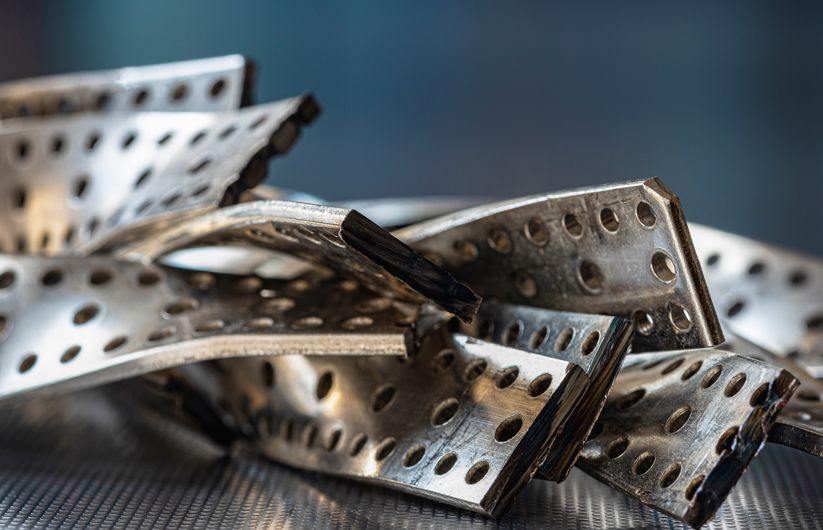
“Recycled material” in industrial forging mostly means steel scrap: metal recovered from structures at the end of their service life, end-of-life vehicles, appliances, e-waste, or the offcuts and rejects a plant generates during its own production process (internal scrap).
The technology that makes this type of recycling possible is the electric arc furnace (EAF), which melts scrap down into new steel. Unlike the blast furnace, which starts with virgin iron ore, the EAF can run on variable percentages of recycled material, adjusting the metallic charge to match the required grade of the final product. That’s actually both the advantage and the challenge at once: scrap offers enormous potential for circularity, but it isn’t a uniform raw material.
Turning scrap into raw material
The process begins with collecting, sorting, and conditioning the scrap — cleaning it, removing non-metallic materials, and analyzing its composition. It then goes into the electric arc furnace, where it’s melted at temperatures above 1,500 °C. During melting and the ladle treatment that follows, ferroalloy additions adjust the chemical composition until the steel reaches the required grade.
The resulting steel is cast into billet or bloom, then hot-worked into the preforms used for forging. At every one of these stages, documented traceability — from the scrap’s origin to the finished product — is essential for recycled steel to be viable in critical applications. For more on how this is managed in EPC environments, see our post on ensuring full traceability in high-risk EPC projects.
Grading scrap by quality and application
There are three main categories:
. High-quality scrap: Industrial offcuts and sorted material with known, stable composition. This is the preferred choice for critical components.
. Medium-quality scrap: Sourced from structures or machinery, it can enter the EAF process under stricter chemical analysis.
. Post-consumer scrap: Vehicles, appliances, municipal waste. This is the most abundant type, but also the most variable, carrying tramp elements (copper chief among them) that are hard to remove. This limits the use of post-consumer scrap in high-performance applications.
This hierarchy is one of the biggest obstacles to scaling up sustainable forging: the raw material in greatest supply is precisely the hardest to use in the industries with the strictest requirements.
Technical advantages and limitations of recycled steel in forging
Whether recycled steel is sustainable in industrial forging isn’t a matter of principle — it’s a matter of specification. The environmental benefits are real and measurable; the technical limitations are too. Together, they determine where recycled material is a viable option today and where it’s still an open challenge.
Environmental benefits and emissions reduction
The environmental case for recycled steel is strong: recycling one ton saves roughly 1,100 kg of iron ore and 630 kg of coal, and cuts CO₂ emissions by about 58% compared with the blast furnace route. Recent research puts a finer point on it: the European CAESAR project used Life Cycle Assessment (LCA) to show that adding 13% conditioned post-consumer scrap to an electric arc furnace’s charge cuts the overall environmental footprint of the process by 12.6% and lowers its greenhouse gas emissions by 8.1%. On top of that, keeping this scrap in Europe means it isn’t exported, avoiding the emissions from international shipping — a significant factor in the overall carbon balance.
Energy savings versus primary production
Producing steel from scrap in an electric arc furnace (EAF) uses 60% to 75% less energy than the blast furnace route. Inside a forging plant, energy savings have an operational dimension of their own, too: improving the thermal efficiency of preform reheating furnaces — through better refractory lining and waste-heat recovery — is another significant lever for sustainability, one that complements the use of recycled material. And before even touching outside scrap, cutting internal scrap is the first circular-economy step, one that’s within reach for any plant.
Purity and chemistry challenges
The main technical hurdle for recycled steel in precision forging is the variable chemistry of the scrap itself: it isn’t a uniform blend, but a shifting mix of steels with different compositions, coatings, and alloying elements. The best-documented problem is tramp elements that melting can’t remove, copper above all, which causes hot shortness above certain concentration thresholds and compromises part integrity, especially in applications exposed to cyclic fatigue or extreme pressure. The result is paradoxical: post-consumer scrap, the most abundant kind, is the kind least used in the industries that need it most in order to meet their ESG targets.
Compatibility across forging processes
Not every forging process is equally sensitive to the starting material’s composition. Closed-die hot forging (flanges, fittings, and piping components) is where requirements are strictest: it demands tightly controlled chemistry, uniform grain structure, and compliance with standards such as ASME B16.5, EN 10222, and API 6A. Here, recycled steel calls for rigorous chemical analysis and complete documented traceability — including EN 10204 Type 3.1 or 3.2 material certificates — without which it’s not viable in EPC projects or in industries like oil & gas, nuclear, or petrochemical. For less critical structural components, by contrast, there’s considerably more room to use scrap.
Emerging technologies improving feasibility
The viability of recycled steel in industrial forging doesn’t rest on the material alone — it also depends on the tools available to characterize, condition, and control it. Four technologies are redefining that limit in 2026.
Advanced analysis and separation systems
Recycled steel’s biggest gains in viability have come from more precise characterization and sorting technologies. Online analysis systems determine the scrap’s elemental composition in real time, letting operators make charge-mix decisions without compromising the steel’s final specification. Alongside them, magnetic, density, and eddy-current separation systems remove unwanted fractions before melting. The CAESAR project mentioned earlier has shown that combining these technologies can turn low-quality post-consumer scrap into a competitive alternative to high-quality scrap, which is scarcer and more expensive on the European market.
Smart metallurgy applied to scrap
Smart metallurgy goes beyond characterization: It applies predictive models trained on historical heat data to optimize the furnace charge for a target steel grade, forecasting the metallurgical outcome within a narrow margin of error. The conceptual shift matters here — in advanced circular metallurgy, tramp elements in the scrap stop being a problem to eliminate and become a strategic resource to manage.
Conditioning recycled material in the metals industry
Conditioning scrap — cleaning, shredding, and sorting it by composition — is the link that turns waste into raw material. The most advanced processes add surface decontamination, controlled shredding, and density- and conductivity-based separation to isolate non-ferrous metals, yielding scrap with a more predictable, controllable composition. Industrial validation under the CAESAR project found that the steel’s metallurgical quality stayed within spec without adding complexity to the production process.
Digital integration in quality control
Digitalization completes the picture: MES (Manufacturing Execution System) platforms linked to analysis equipment and melting processes log the traceability of each heat in real time, generating the documentation needed to prove the material’s origin and properties to customers and auditors. In EPC projects, where documenting every component is a contractual requirement, this digital integration turns next-level quality control into a competitive edge for a supplier.
Economic and regulatory obstacles in 2026
The technical viability of recycled steel in industrial forging is already proven. What’s changing now is the economic and regulatory environment around it: new obligations for importers, mounting pressure from up and down the value chain, and a carbon market that’s starting to charge for what used to be free.
Carbon certificate costs and CBAM regulation
As of January 1, 2026, the Carbon Border Adjustment Mechanism (CBAM) is fully mandatory for companies importing iron and steel from outside the European Union. Companies importing more than 50 metric tons a year must declare the CO₂ emissions tied to producing those goods and buy certificates to offset them. The goal is to level the playing field between European producers — who already pay under the EU Emissions Trading System (ETS) — and suppliers in other countries that don’t bear that cost. By closing that gap, CBAM effectively makes higher-carbon imported steel more expensive. For procurement departments and EPC integrators, this adds a new factor to supplier evaluation: from 2026 on, a documented lower carbon footprint is a real competitive advantage in the economics of a tender.
The equipment investment required
The shift to sustainable, recycled-material-based forging doesn’t come free. Online spectroscopic analysis systems, scrap-conditioning lines, and digital heat-traceability systems all represent significant investments that only pay off at industrial scale.
For mid-sized manufacturers, getting access to these technologies may mean partnering with steel mills or technology centers, or building specialized supply chains that secure a steady supply of pre-sorted, documented scrap. Because Europe’s recycling sector is so fragmented, this logistical challenge is, in many cases, every bit as complex as the technical one.
Competing with traditional suppliers
Steel made from high-quality scrap is price-competitive with primary steel, but steel from conditioned post-consumer scrap — the more sustainable option — can’t always compete with steel imported from outside the EU, whose producers pay neither for conditioning nor for European emissions allowances. CBAM narrows that gap somewhat as of 2026, though how much depends on where carbon prices in the ETS market go and how strictly the regulation is actually enforced. In that landscape, European forgers are competing on two fronts at once: technical product quality and documented environmental credentials, where a proven carbon footprint, recycled-content percentage, and origin traceability carry as much weight as price or lead time.
What OEM manufacturers are demanding
OEM (Original Equipment Manufacturer) buyers in sectors like oil & gas, energy, and transportation are building sustainability criteria into their purchasing specifications. That translates into concrete requirements: a minimum recycled-content percentage in supplied materials, documented carbon footprint for the production process through Environmental Product Declarations (EPD), and compliance with ESG reporting standards.
Where steel’s circular economy is headed
The results of the CAESAR project show that the ceiling for recycled steel in high-performance applications is considerably higher than assumed. The paradigm shift is as much conceptual as technological: the circular economy of steel isn’t about recycling more volume — it’s about preserving as much value as possible from every material, turning the tramp elements in scrap into strategic resources rather than impurities to remove.
For industrial forging, that means that as characterization and conditioning technologies mature, the usable raw-material base widens, and reliance on high-quality scrap eases. Sustainable forging isn’t some future goal — it’s a transition already underway, with proven technology, regulation already in force, and real demand from the highest-value markets.
In short, recycled steel in industrial forging is already a technical reality, backed by regulation and increasingly justified on economic grounds. Data from the CAESAR project found that post-consumer scrap, which until recently was being exported out of Europe, can go into manufacturing high-performance steel without compromising metallurgical quality, provided the right characterization, conditioning, and control technologies are applied.
The challenges remain real. Scrap variability, equipment investment, sourcing logistics, and the documentation demands of critical projects set an entry bar that not every supplier can clear. But sustainable forging isn’t a generic commitment — it’s a capability proven through verified processes, documented traceability, and certifications that back up every step of the production chain. That’s what makes it a competitive advantage