


Non-Destructive Testing of Forged Parts: A Comprehensive Technical Guide
Non-destructive testing (NDT) is a key tool for ensuring the quality and safety of critical industrial components in the forging process. NDT inspection techniques make it possible to analyze the properties and condition of the material without damaging it or reducing its useful life. This is particularly important in the case of high-value forged parts.
Non-destructive tests can be applied at any stage of the manufacturing process as well as during the component’s service life. This is why they have become an essential part of modern-day quality control. By allowing 100% of production to be evaluated, they can significantly increase the safety, quality, and reliability of the final product. This is especially important for forged components intended for sectors where safety is critical, such as aeronautics, railways, and the automotive industry.
Importance of non-destructive testing in forged parts
In modern industry, the early detection of hard-to-detect or hidden defects is fundamental to ensuring safety and profitability. This is why non-destructive testing is so valuable in the forging sector, where each component must meet strict technical specifications.
Risk reduction in critical components
NDT in forging allows for the identification of defects such as cracks, corrosion, manufacturing faults, or shape irregularities before they cause major problems. This preventive capability is crucial for forged components intended for high-risk industries where structural integrity is vital to preventing accidents.
Key benefits include:
. Increased safety by preventing failures that could cause accidents
. Cost savings by avoiding costly repairs or unexpected downtime
. Optimized maintenance, extending the service life of equipment
. Traceability and regulatory compliance, as NDT inspection generates records and documented evidence of the component’s condition
Quality control without damaging the part
Unlike destructive testing, which allows only samples from a specific batch to be inspected, NDT inspection allows the entire production run to be examined, significantly increasing the safety and reliability of the final product.
Non-destructive testing is useful during all stages of production, from the receipt of raw materials on through manufacturing processes, final inspection, and monitoring during service. It ensures the integrity and functionality of the parts without compromising their physical, chemical, mechanical, or dimensional properties.
Compliance with international standards
In many safety‑critical sectors such as aerospace and automotive, non‑destructive testing is mandatory and an integral part of quality standards. Standards such as ISO 9712 include procedures and requirements for certifying the personnel who perform these tests. These standards ensure that operators have the necessary theoretical knowledge and practical skills to perform accurate and reliable tests. In this way, in addition to reducing the risk of penalties, companies strengthen their competitive position in international markets where compliance with these standards is mandatory.
Main methods of non-destructive testing (NDT)
NDT inspections encompass a variety of specialized techniques, each based on different physical principles. These complementary approaches make it possible to detect different types of discontinuities according to the specific needs of each component.
Visual inspection (VT)
Visual inspection, or VT, is the most basic and widely used method. As its name suggests, this test allows surface discontinuities to be detected through direct or assisted observation. VT is an independent process that serves as an essential preliminary step before applying any other NDT method. When performed correctly, it significantly reduces the need for further testing. VT can be performed by direct inspection, i.e., at close range using magnifying glasses or microscopes, or remotely using endoscopes for hard-to-access cavities.
Penetrant Testing (PT)
This method uses capillary action to detect surface discontinuities in non-porous materials. The process involves applying the penetrant, removing the excess, developing it, and observing the results. PT is ideal for forged parts made of non-ferromagnetic materials because it can detect very fine surface cracks with high sensitivity (down to defects less than 1 micron wide).
Magnetic particles (MT)
Based on magnetism, this test detects surface and subsurface discontinuities in ferromagnetic materials. The principle is simple: magnetic particles accumulate in areas where defects exist, making them visible by contrast. This method is frequently used on safety-critical forged components such as axles, springs, and steering components.
Ultrasound (UT)
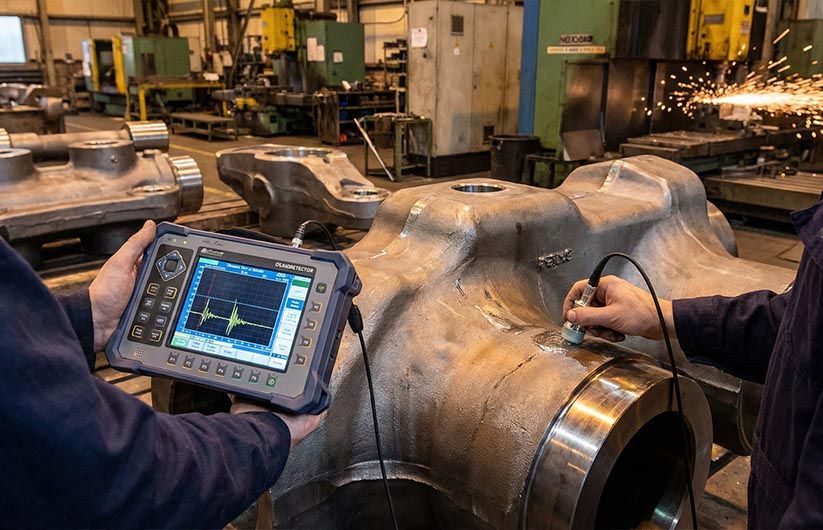
This method uses ultrasonic waves that propagate through the material and allow internal imperfections such as lamination defects or fatigue failures to be detected. It is particularly effective on forged parts and provides information on the exact location of the defect. Applications include weld inspection, structural evaluation of forged parts, and fatigue failure detection.
Industrial radiography (RT)
This method uses X-rays or gamma rays to penetrate materials and detect internal volumetric discontinuities. The differential absorption of radiation produces a two-dimensional image displaying any internal heterogeneity. RT provides a permanent record and allows for the detection of porosity, inclusions, cracks, and voids inside the welds of forged parts.
Induced currents or Eddy currents
Based on electromagnetic induction, this method uses alternating magnetic fields to detect anomalies in metal objects. It is particularly useful for inspecting surface and subsurface cracks in forged blades and shafts, eliminating the need to remove non-metallic coatings. It also enables the detection of cracks in corroded areas of forged components.
Practical applications in the forging industry
Non-destructive testing is used to inspect many critical components in high-risk industries, such as automotive, aerospace, and energy.
Inspection of forged flanges and shafts
Large-diameter flanges, which are widely used in wastewater treatment and wind energy, require thorough quality checks. Visual inspection detects cracks and surface voids, and chemical composition analysis ensures that materials are suitable for their intended use. Similarly, for forged shafts, dimensional accuracy, surface roughness, and shape and position accuracy are evaluated using vernier calipers and micrometers.
Weld inspection on forged parts
Monitoring welds is essential for critical components. Automated systems monitor parameters such as voltage, intensity, and filler metal speed, recording up to ten data points per second. These non-destructive techniques significantly improve quality in the automotive, aerospace, and construction sectors. They also enable the generation of automatic reports that centralize information on all welds present in a part.
Integrity verification in machining processes
During machining, technologically advanced devices such as coordinate measuring machines and laser scanners verify the process and identify minimal deviations. Controlling cutting parameters (e.g., speed and depth) is essential for maintaining quality. There are also detailed records starting from material selection up to the final product to ensure traceability.
Evaluation of parts subject to fatigue
Fatigue resistance is crucial for forged components such as crankshafts and connecting rods. These parts are evaluated using cyclic tests on high-frequency pulsators that can apply loads of up to 600 kN and frequencies of up to 285 Hz. This type of testing determines long-term resistance and predicts failures before they occur. As a result, the service life of safety-critical components is optimized.
Regulations, certifications, and qualified personnel
To guarantee the quality of NDT forging tests, rigorous regulatory frameworks govern procedures and personnel certifications. The most important ones are described below.
Applicable ISO, ASTM, and EN standards
The forging industry is governed by various international standards. UNE-EN ISO 9712 is the primary standard for qualifying and certifying personnel who perform non-destructive testing. Additionally, specific standards such as ASTM E1570, ISO 11971, and UNE-EN 10228 regulate procedures for forged parts. The UNE-EN 10228 series is dedicated specifically to the non-destructive testing of forged steel parts and addresses subjects such as magnetic particle and ultrasonic inspection.
Personnel certification (Levels 1, 2, and 3)
Personnel certification is structured into three levels with different responsibilities:
. Level 1 personnel can perform tests following written instructions, but cannot evaluate results.
. Level 2 personnel can perform, interpret, and evaluate tests according to established criteria.
. Level 3 personnel have the knowledge to interpret codes and standards and serve as the highest technical authority.
Importance of experience and continuous training
The certification process requires training, experience, evaluation, and an annual visual examination. To obtain certification according to UNE-EN ISO 9712, one must meet the minimum requirements for training and supervised practical experience. Likewise, maintaining certification requires renewal every five years and recertification every ten years to ensure knowledge remains up to date.