


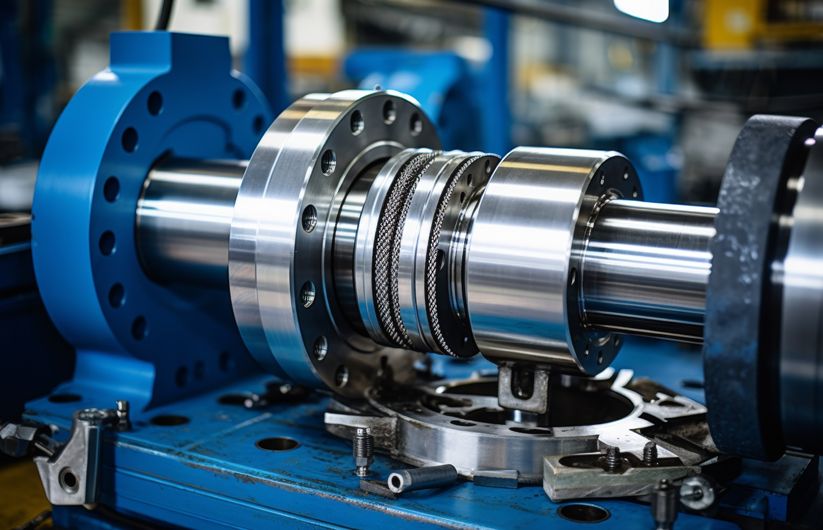
Forged vs. Machined Flanges: Choosing Based on Pressure and Strength
Flanges may look alike at a glance, but they aren’t all the same. A forged flange and one that’s cut directly from bar or plate can share the same dimensions, the same surface finish, and the same nominal material grade, yet behave radically differently under pressure, temperature, and cyclic loads. That’s why a wrong choice carries consequences that go well beyond the component itself.
Industrial flanges and how they’re made
Flanges are the connecting components that join pipes, valves, and equipment in industrial processing systems, making it easy to assemble, inspect, and disassemble a line without cutting the pipe. Their job looks simple, but in systems that run at high pressure, at extreme temperatures, or with hazardous fluids, every flange’s integrity is critical to safety. And that integrity starts with how the flange is made.
The role of flanges in piping systems
A flange joins a pipe to another pipe, a valve, a heat exchanger, or any other equipment, using a pair of mating faces sealed with a gasket and tightened with bolts. This removable connection is what sets it apart from a weld: it gives access to the inside of the system for inspection, cleaning, or component replacement without disturbing the piping.
In industrial processing systems, flanges don’t operate under static conditions. They are exposed to internal pressure, varying temperatures, vibration, bending-moment loads, and thermal expansion cycles. Each of these puts stress on the component, and the material has to absorb it without deforming or losing its seal. How well it can do that depends largely on how the flange was made.
The forging process
In forging, steel is heated to forging temperature, typically between 1100 °C and 1250 °C, and shaped under controlled pressure by presses or hammers. This hot plastic deformation isn’t only a shaping step: it transforms the material’s internal structure.
During forging, the steel’s grain flow aligns with the contour of the part. Porosity, segregation, and inclusions in the starting material are closed up or redistributed, leaving a denser, more homogeneous structure. The finished component ends up with mechanical properties (tensile strength, toughness, fatigue strength) superior to those of the same material unworked.
Machining from bar or plate
Machined flanges are made by removing material. Starting from a rolled bar or a steel plate, the excess is cut away by turning, milling, and drilling until the part takes its final shape. The process offers high dimensional precision, but with one fundamental difference from forging: it doesn’t change the internal structure of the starting material.
In a flange machined from plate, the grain flow of the rolled steel is interrupted wherever material has been removed. That means the component’s mechanical properties are those of the base material, and there may be areas where the grain orientation isn’t favorable to the loads the component will carry in service.
Key technical differences between forged and machined flanges
The manufacturing process is no minor detail. It determines the component’s internal structure and, with it, how it actually behaves in service. The differences between a forged and a non-forged flange can’t be seen with the naked eye, but they show up clearly when the component works under demanding conditions.
Internal structure: grain flow and porosity
The biggest difference between the two processes lies inside the material. In a forged flange, hot plastic deformation aligns the grain flow with the contour of the part, closing up porosity and redistributing inclusions. The result is a dense, homogeneous structure, oriented in the direction best suited to resisting service loads.
In a machined flange made from bar or plate, the grain flow of the rolled starting material is interrupted wherever material has been removed. The internal structure hasn’t been modified or optimized: it reflects the material exactly as it came out of rolling, with the limitations this implies for homogeneity and strength in every direction of loading.
This difference matters most in components subjected to cyclic fatigue, impact, or multiaxial loads, where grain orientation determines the areas of lowest strength, and therefore the points where a crack can start.
Strength, dimensional precision, and behavior under pressure
The structural advantage of forging shows up in the numbers: forged parts offer 20% to 30% more fatigue strength than the same material machined from bar or plate. That difference isn’t marginal in components that operate in systems with cyclic pressure or in environments with sustained vibration.
As for dimensional precision, machining produces tighter tolerances and a more controlled surface finish than an as-forged part. In practice, though, forged flanges go through finish machining that meets the dimensional tolerances required by standards such as ASME B16.5. That takes this difference out of the equation entirely. The combined process (forging for structure, CNC machining for final geometry) is standard in the production of flanges for critical applications.
Under pressure, the difference in fabrication is decisive in the higher class numbers. For ASME pressure classes 150 and 300, a machined flange in a suitable material can be acceptable for non-critical applications. From Class 600 upwards, and especially in Classes 900, 1500, and 2500, forging is more than the preferred option: it’s the process that makes it possible for the component to meet the strength requirements the standards impose and actual service conditions demand.
Selection criteria by pressure and application
Knowing the technical differences between the two processes is only the starting point. The practical decision on which flange to specify for a particular project depends on three factors that have to be weighed together: the system’s pressure class, the service conditions, and the industry it serves. In many cases, the standards already supply the answer.
ASME pressure classes and when they call for forging
ASME B16.5 sets seven pressure classes for flanges: 150, 300, 400, 600, 900, 1500, and 2500. Each class defines the maximum allowable pressure for a given material and operating temperature. As the class number rises, the requirements for material strength and component integrity become stricter.
In the lower pressure classes, for non-critical applications at moderate temperatures, a machined flange in a suitable material can meet the requirements. Starting from Class 600, forging becomes the technically recommended option. In Classes 1500 and 2500, which cover very high-pressure systems, the internal structure forging produces is decisive for ensuring the component’s integrity under the most demanding loads. At these levels, the standards all but rule out flanges machined from plate.
Where machined flanges are sufficient
Machined flanges have their place in low-pressure, non-critical service: industrial water systems, HVAC installations, low-temperature circuits, or process piping carrying non-hazardous fluids. In these settings, the applicable standards, such as AS 2129, BS 10, and AS 4087, don’t impose the same structural integrity requirements as ASME B16.5, and a machined flange is a dimensionally precise, cost-competitive solution.
The key is that the service environment doesn’t subject the component to the combined loads (pressure, temperature, fatigue, impact) that make the structural improvement of forging necessary. When those conditions are absent, the added cost of a forged flange isn’t justified on technical grounds.
Industries and conditions that require forged flanges
In oil & gas, petrochemicals, power generation, mineral processing, and nuclear plants, forged flanges aren’t just the preferred option—they’re the standard. Piping systems in these industries carry fluids at high pressure and temperature, often hazardous or corrosive, in continuous operation where a component failure has serious consequences for safety, production, and the environment.
In these settings, material requirements go beyond mechanical strength. They call for specific steel grades (ASTM A182 F316, duplex F51, F22 for high temperature), properties verified by testing, and complete, documented traceability that proves where the material came from and what its characteristics are, from the melt to the finished component. A flange machined from plate to a generic specification can’t meet any of these requirements.
Applicable standards and documented traceability
Choosing the right manufacturing process is necessary, but it isn’t enough. On demanding industrial projects, a forged flange without the right documentation is worth no more than an uncertified one: it can’t be accepted on site, the installation can’t be legally approved, and its fitness for service can’t be assured. Standards and traceability documentation are what turn a technically sound component into a contractually valid one.
ASME B16.5 and ASTM A182: what they require of the manufacturer
ASME B16.5 is the standard of reference for forged flanges in medium- and high-pressure piping systems. It sets out the dimensional requirements, permitted materials, pressure classes, and test conditions that apply to each component. As noted above, compliance isn’t optional in some industries: it’s a contractual and regulatory requirement that determines whether a component is accepted on site.
The ASTM A182 standard complements ASME B16.5 from the materials side: it specifies the requirements for chemical composition and mechanical properties of the forged steels used to make high-pressure, high-temperature flanges. Each material grade has its own specific requirements, which the manufacturer must meet and document.
Material certification and heat traceability
On EPC (Engineering, Procurement, and Construction) projects and in facilities subject to industrial safety regulations, forged components must come with material certificates that document their chemical composition and mechanical properties. EN 10204 defines the acceptable certificate types. Type 3.1, issued by the manufacturer and checked by its own quality department, and Type 3.2, which adds validation by an independent inspector, are the ones required in critical applications. Missing or incomplete certificates can hold up the receipt of materials and delay start-up of the facility.
The heat number is the identifier that ties each forged flange to the melt of steel it came from. It makes it possible to trace, at any time, the exact composition of the material, the heat treatment it has undergone, and the tests run on that heat. In systems where metallurgical compatibility between components is critical, heat traceability isn’t an administrative detail: it’s central to the integrity of the system.
Required flange markings and delivery documentation
Every forged flange that complies with ASME B16.5 must carry a set of required markings, applied directly on the component: manufacturer identification, material grade, nominal size, pressure class, applicable standard number, and heat number. This marking isn’t a formality. It’s the physical link between the component and its technical documentation, and it lets you verify at any time that the installed component matches the certificate that came with it.
The complete documentation package that has to accompany a forged flange on critical projects includes the material certificate, reports on the non-destructive testing done during manufacturing, dimensional inspections, and, where applicable, hydrostatic test results and hardness checks. This technical file lets the project’s purchasing and quality teams verify the material’s suitability before installation, and it stays on file as the installation’s as-built documentation for its entire service life.
Behind every flange specification lies an engineering decision, and it should rest on three clear criteria: the system’s pressure class, the actual service conditions, and the project’s regulatory and documentation requirements. When all three point the same way, the answer is always the same: a forged flange, with full certification.
A flange is a seemingly simple component. But behind its outward appearance sit a material choice, a manufacturing process, and a documentation chain that together determine whether it can protect the system’s integrity over its entire service life. Understanding the differences between forging and machining from bar stock or plate is the starting point for any sound specification.