


Hot-Rolled Steel: Properties, Advantages, and Industrial Applications
Hot-rolled steel is notable for its combination of strength and flexibility, allowing it to be formed into various shapes and dimensions. Obtained through a high-temperature forming process, it offers an ideal balance between mechanical performance and cost efficiency. This makes it indispensable in numerous industrial and structural applications.
What is hot-rolled steel?
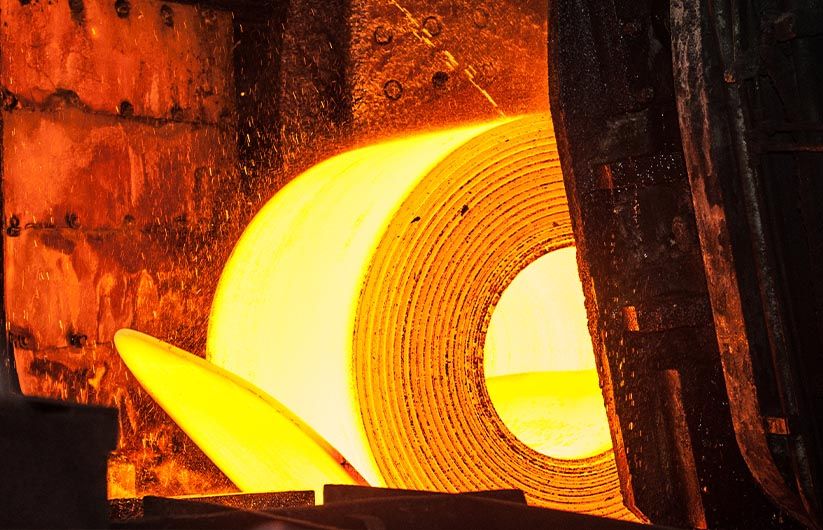
Hot-rolled steel is produced at a temperature above 926 °C to prevent recrystallization. As a result, this steel can be shaped much more easily than cold-rolled steel, requiring much less force to deform. Additionally, the process can begin with larger and heavier starting material, such as thick ingots or slabs.
Fundamental properties and characteristics of hot-rolled steel
Several key properties distinguish hot-rolled steel from other steel types. These characteristics stem directly from the high-temperature forming process, in which the metal acquires a more uniform internal structure and excellent formability.
- Rounded edges: During cooling, the steel naturally contracts, rounding corners and eliminating sharp angles.
- Rough surface: As the steel cools from high temperatures, an oxide film forms on the surface, leaving it irregular and textured.
- Slight distortions: Variations in cooling rates cause minor dimensional changes, so finished pieces may not be perfectly rectangular.
Advantages of hot-rolled steel
Hot-rolled steel offers several advantages that make it highly valued across industries.
- Competitive cost: Hot-rolled steel costs less to produce than cold-rolled steel, making it a more economical choice.
- Versatility: It can be formed into a wide variety of shapes, sizes, and thicknesses, making it well-suited for structural applications, machinery, and automotive components.
- High-strength applications: Its combination of toughness, ductility, and load-bearing capacity makes it ideal for beams, columns, chassis, and other components subjected to high stress.
Disadvantages and limitations
Like any material, hot-rolled steel has limitations that must be considered during material selection.
- Dimensional tolerances: Hot-rolled steel has wider dimensional tolerances than cold-rolled steel due to thermal contraction during cooling, resulting in greater variation in final length, width, thickness and shape.
- Rough surface finish: The scaly surface may require additional finishing for certain applications.
- Limitations in precision applications: Hot-rolled steel is not recommended for parts requiring tight tolerances or precise fits due to its dimensional variability and surface irregularities.
- Lower strength: It has less tensile strength than cold-rolled steel, making it less resistant in that sense.
Industrial uses and applications of hot-rolled steel
Due to its strength, versatility, formability, and low production cost, hot-rolled steel is one of the most widely used materials in industry. Key industrial applications include:
- Heavy machinery: Used in chassis, frames, axles, gears, and structural components for industrial and agricultural equipment. Its high strength and load-bearing capacity make it ideal for earth-moving equipment, cranes, excavators, presses, and other machinery subjected to heavy mechanical stress.
- Automotive: Used in vehicle bodies, structural reinforcements, and chassis due to its impact resistance and energy absorption.
- Construction: Widely used for structural beams, columns, and load-bearing components in bridges, buildings, and infrastructure projects.
- Shipbuilding: Used in hulls, decks, and offshore platforms, it can offer good marine corrosion resistance.
- Pipelines and tubing: Hot-rolled steel is used in oil and gas pipelines and industrial piping, often in corrosion-resistant grades or with protective coatings for harsh environments.
How to choose the right hot-rolled steel for your project
Selecting the right hot-rolled steel requires careful consideration of factors that directly affect performance and project outcomes. Size, geometry, and dimensional tolerances must align with design specifications and end-use requirements. Hot-rolled steel is especially well-suited for large components and structural profiles where tight dimensional tolerances are not critical. Its lower cost and straightforward manufacturing process make it an economical choice for large structures, machinery, and industrial components.
Before finalizing material selection, it is also crucial to consider the steel grade or standard, dimensional tolerance requirements, and any additional treatments or coatings needed for durability or finish. Verify available product formats, custom fabrication capabilities, and lead times as well. ULMA Forja provides expert technical support to help you select the most appropriate steel grade and product form for your application. Our catalog features high-quality forged components backed by experienced and dedicated technical and customer support teams.